Table of Contents
Introduction to AI SEO Metrics
The search landscape has changed dramatically with the rise of AI-powered search engines and generative AI tools. As search engines like Google integrate AI features such as AI Overviews and AI Mode, and platforms like ChatGPT, Claude, and Perplexity gain popularity as information sources, the way we measure SEO success must evolve.
Traditional SEO metrics focused on rankings, traffic, and clicks. While these metrics remain valuable, they don't fully capture how your content performs in AI-driven search environments. In 2025, you need to track new metrics that reflect your content's visibility and impact in AI search results.
This article explores the most important AI SEO metrics you should be tracking in 2025, how they differ from traditional metrics, and how to measure them effectively. Whether you're optimizing for Google's AI features or for standalone AI platforms, these metrics will help you understand and improve your performance in the AI search ecosystem.
Traditional SEO Metrics vs. AI SEO Metrics
Before diving into specific AI SEO metrics, it's important to understand how they differ from traditional SEO metrics. While traditional metrics focus on search engine results pages (SERPs) and website traffic, AI SEO metrics measure how your content performs within AI-generated answers and recommendations.
| Aspect | Traditional SEO Metrics | AI SEO Metrics |
|---|---|---|
| Primary Goal | Rank high on search engine results pages (SERPs) to drive organic traffic | Be retrieved, reranked, and cited in AI-generated answers |
| Optimization Level | Page-level optimization (title tags, meta descriptions, keywords) | Passage-level optimization: individual sections, FAQs, or tables must stand alone as authoritative, extractable answers |
| Content Strategy | Focus on keyword targeting and backlink acquisition | Focus on semantic coverage: expand topical depth, cover related entities, synonyms, and adjacent queries |
| Freshness | Evergreen content can sustain rankings with minor updates | Freshness scoring is always on—newer content is prioritized; cornerstone assets must be updated frequently |
| Measurement of Success | Higher rankings, traffic, click-through rates | Inclusion and citation in AI-generated answers; visibility across AI ecosystems |
As you can see, AI SEO metrics focus more on how your content is used by AI systems rather than just how it ranks in search results. This shift requires new measurement approaches and tools to fully understand your content's performance in the AI search ecosystem.
Key AI SEO Metrics to Track in 2025
Here are the most important AI SEO metrics you should be tracking in 2025 to measure your success in AI search environments:
1. AI Visibility Rate (AIGVR)
AI Visibility Rate measures how often your content appears in AI-generated answers. This metric shows the frequency and prominence of your content in AI search results, giving you a clear picture of your overall visibility in AI ecosystems.
Unlike traditional organic impressions, which only show how often your site appears in SERPs, AIGVR focuses specifically on AI-generated results. A high AIGVR indicates that AI systems consider your content relevant and authoritative enough to include in their answers.
2. Citation Rate
Citation Rate tracks how often your brand or content is directly quoted or referenced by AI systems. This metric goes beyond simple visibility to measure actual attribution in AI-generated answers.
Citations are particularly valuable because they explicitly connect your brand to the information provided, building authority and recognition. A high Citation Rate suggests that AI systems not only find your content useful but also consider it worthy of direct attribution.
3. Content Extraction Rate (CER)
Content Extraction Rate measures how often AI systems extract and use specific passages or data points from your content. This metric helps you understand which parts of your content are most valuable to AI systems.
By tracking CER, you can identify which content formats (FAQs, tables, lists, etc.) and topics are most likely to be extracted and used by AI systems. This information can guide your content creation strategy to focus on formats that perform well in AI search.
4. Passage-Level Visibility
Passage-Level Visibility tracks which specific content blocks (paragraphs, FAQs, tables, snippets) are referenced by AI systems. This metric provides granular insight into which parts of your content are most valuable for AI search.
Unlike traditional page-level metrics, Passage-Level Visibility shows you exactly which sections of your content are performing well in AI search. This can help you optimize your content structure and focus on creating more of the content types that AI systems prefer.
5. Conversation-to-Conversion Rate
Conversation-to-Conversion Rate measures the percentage of AI-cited content engagements that lead to a measurable business action. This metric connects AI search visibility to actual business outcomes.
By tracking how often users take action after seeing your brand cited in AI conversations, you can measure the real business impact of your AI SEO efforts. This metric helps justify investment in AI SEO by showing its contribution to your bottom line.
6. AI-Driven Conversion Lift
AI-Driven Conversion Lift measures the incremental conversions traced back to AI conversations. This metric isolates the impact of AI search on your conversion rates, helping you understand its unique contribution to your business.
By comparing conversion rates from AI search to those from traditional search, you can quantify the additional value that AI search brings to your business. This information can inform your resource allocation and strategy decisions.
7. AI Trust Signals
AI Trust Signals measure how often AI models ground their answers in your brand or content. This metric reflects the level of trust that AI systems place in your content as an authoritative source.
Strong AI Trust Signals indicate that AI systems consider your content reliable and authoritative enough to use as a foundation for their answers. Building these signals requires creating factual, well-structured, and authoritative content that AI systems can easily verify and trust.
8. Entity Authority Score
Entity Authority Score measures the visibility of your brand across AI knowledge graphs and entity networks. This metric reflects how well AI systems understand your brand as an entity and its relationships to other entities.
A high Entity Authority Score means that AI systems have a clear understanding of your brand's identity, expertise, and relationships. This understanding makes it more likely that your brand will be cited in relevant AI-generated answers.
9. Semantic Footprint Growth
Semantic Footprint Growth tracks the expansion of entity and topic coverage across AI-cited clusters. This metric shows how your content's semantic reach is growing over time.
By monitoring which topics and entities your content is associated with in AI systems, you can identify opportunities to expand your semantic footprint and increase your visibility across a broader range of queries.
10. Query Fan-Out Coverage
Query Fan-Out Coverage measures the breadth of adjacent queries where your content is referenced. This metric reflects how well your content addresses related questions and topics that AI systems might explore when answering a user query.
Strong Query Fan-Out Coverage indicates that your content is comprehensive enough to be relevant to a wide range of related queries. This breadth increases your chances of being cited in AI-generated answers across various user intents.
11. AI Crawl Indexability
AI Crawl Indexability measures whether AI crawlers (e.g., ChatGPT-User) can access and index your site. This metric is a technical foundation for AI search visibility.
Without proper AI Crawl Indexability, your content may be invisible to AI systems regardless of its quality. Ensuring that AI crawlers can access your site is a basic requirement for AI SEO success.
12. Extraction Success Rate
Extraction Success Rate measures how easily structured content (schema, lists, tables) is parsed and reused by AI. This metric reflects the technical quality of your content structure from an AI perspective.
A high Extraction Success Rate means that AI systems can easily understand and use your structured content. This makes it more likely that your content will be cited in AI-generated answers.
Tools for Measuring AI SEO Performance
Measuring AI SEO performance requires specialized tools and approaches. Here are some effective methods and tools for tracking AI SEO metrics:
Log File Analysis
Log file analysis is one of the most reliable methods for tracking AI-driven usage of your content. Unlike JavaScript analytics, server logs capture every request made to your server, including those from AI crawlers like ChatGPT-User.
By analyzing your server logs, you can identify which pages are being accessed by AI systems and how often. This provides direct evidence of AI engagement with your content that might be missed by traditional analytics tools.
Google Search Console AI Mode Data
Google has added AI Mode data to Search Console, allowing you to track how your content performs in Google's AI-powered search features. This data shows how often your content appears in AI Overviews and other AI-driven search results.
By monitoring this data, you can understand how Google's AI features are affecting your visibility and traffic. This information can help you optimize your content for better performance in Google's AI search results.
Specialized AI SEO Tools
Several specialized tools have emerged to help track AI SEO performance. These tools offer features like AI visibility tracking, citation monitoring, and semantic analysis to help you understand your content's performance in AI search.
Some popular AI SEO tools include:
- Semrush Enterprise AIO: Measures your visibility and sentiments in AI conversations across various models
- Barracuda: Analyzes content on a passage-by-passage level for clarity, fact-density, and semantic relevance
- Custom log parsing tools: Extract and analyze AI crawler activity from your server logs
Custom Tracking Solutions
For enterprise-level needs, custom tracking solutions may be necessary to fully capture AI SEO performance. These solutions can include:
- Automated log parsing at scale: Continuously scan server logs to surface AI-driven visits in near real-time
- Passage-level detection: Identify which specific sections of your content are being cited by AI systems
- Semantic mapping dashboards: Visualize clusters of content being referenced across AI queries
- Integration with CRMs and attribution models: Connect AI-driven visits to downstream revenue
By combining these tools and approaches, you can build a comprehensive view of your AI SEO performance and identify opportunities for improvement.
Generative Engine Optimization (GEO) Metrics
Generative Engine Optimization (GEO) is the practice of optimizing content to be visible, referenced, and cited within AI-generated answers. GEO metrics focus specifically on how your content performs in generative AI environments like ChatGPT, Claude, and Google's AI features.
What is Generative Engine Optimization (GEO)?
GEO is the emerging practice of optimizing content so it is visible, referenced, and cited within AI-generated answers from systems like Google's AI Overviews, Google's AI Mode, or ChatGPT—rather than just ranking in traditional search engine results. Unlike older methods of SEO, which focus on climbing SERPs through keywords and backlinks, GEO emphasizes creating factual, authoritative, semantically rich, and well-structured content that large language models (LLMs) can easily interpret.
Key GEO Metrics to Track
1. Chunk Retrieval Frequency
This metric measures how often a modular content block is retrieved in response to prompts. It reflects how frequently AI systems pull specific chunks of your content when generating answers.
2. Embedding Relevance Score
This metric measures the similarity score between query and content embeddings. It reflects how well your content aligns with search intent from an AI perspective.
3. Attribution Rate in AI Outputs
This metric tracks how often your brand or site is cited in AI answers. It measures direct attribution in AI-generated content.
4. AI Citation Count
This metric counts total references to your content across LLMs. It measures overall citation frequency across different AI platforms.
5. Vector Index Presence Rate
This metric measures the percentage of your content successfully indexed into vector stores. It reflects how well your content is represented in the vector databases that power many AI systems.
6. Retrieval Confidence Score
This metric measures the model's likelihood estimation when selecting your chunk. It reflects how confident AI systems are when choosing your content.
7. RRF Rank Contribution
This metric measures how much your chunk influences final re-ranked results. It reflects your content's weight in the AI's ranking process.
8. LLM Answer Coverage
This metric counts the number of distinct prompts your content helps resolve. It measures the breadth of queries your content can address.
9. AI Model Crawl Success Rate
This metric measures how much of your site AI bots can successfully ingest. It reflects the technical accessibility of your content to AI crawlers.
10. Semantic Density Score
This metric measures the richness of meaning, relationships, and facts per chunk. It reflects how information-dense your content is from an AI perspective.
11. Zero-click Surface Presence
This metric measures your appearance in systems that don't require links to deliver answers. It tracks exposure rather than traffic.
12. Machine-validated Authority
This metric measures authority as judged by machines, not links. It reflects how AI systems evaluate your content's authority.
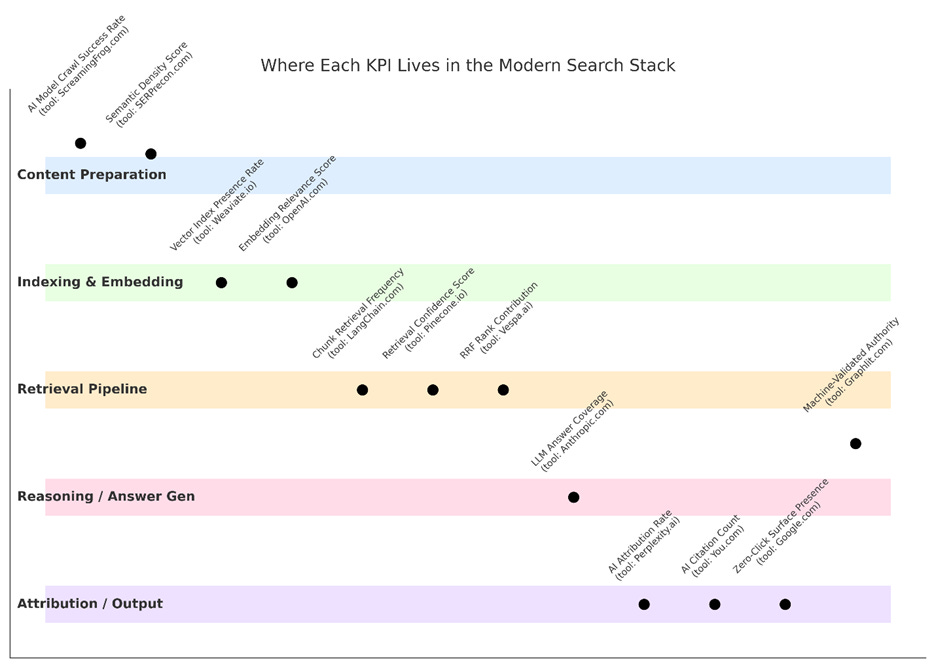
GEO metrics mapped to different layers of the AI search stack
Future of AI SEO Metrics
As AI search continues to evolve, we can expect AI SEO metrics to become even more sophisticated and important. Here are some trends to watch in the future of AI SEO metrics:
Integration of AI Metrics with Business Outcomes
In the future, we'll see tighter integration between AI SEO metrics and business outcomes. This will involve more advanced attribution models that can track the full customer journey from AI search exposure to conversion, providing a clearer picture of AI SEO's business impact.
Multi-modal Metrics
As AI search becomes more multi-modal, incorporating images, video, and audio, we'll need metrics that can track performance across these different content types. This will include metrics for image recognition, video content extraction, and audio citation.
Personalization Impact Metrics
AI search is becoming increasingly personalized, showing different results to different users based on their preferences and behavior. Future metrics will need to account for this personalization, measuring how your content performs across different user segments and personalization contexts.
Real-time Optimization Metrics
As AI systems become more dynamic, updating their knowledge and responses in real-time, we'll need metrics that can track performance on a more immediate timescale. This will include real-time monitoring of AI citations and visibility, allowing for faster optimization and response.
Cross-platform AI Visibility Metrics
With the proliferation of AI platforms and tools, we'll need metrics that can track performance across the entire AI ecosystem. This will include unified visibility scores that aggregate performance across different AI platforms, providing a comprehensive view of AI search presence.
Frequently Asked Questions
How do AI SEO metrics differ from traditional SEO metrics?
+AI SEO metrics focus on how your content is used by AI systems rather than just how it ranks in search results. While traditional SEO metrics like rankings and traffic measure visibility in search engine results pages (SERPs), AI SEO metrics measure how your content is retrieved, ranked, and cited within AI-generated answers. This includes metrics like AI Visibility Rate, Citation Rate, and Content Extraction Rate, which track how AI systems interact with and use your content. The key difference is that AI SEO metrics look at your content's performance within AI systems themselves, not just its ability to attract clicks from search results.
Why are traditional SEO metrics no longer enough in 2025?
+Traditional SEO metrics are no longer enough in 2025 because they don't capture how your content performs in AI-driven search environments. With the rise of AI search features like Google's AI Overviews and AI Mode, and standalone AI platforms like ChatGPT and Claude, users are increasingly getting information directly from AI-generated answers without clicking through to websites. This means that traffic and click-based metrics miss a significant portion of your content's impact. Additionally, AI systems evaluate and use content differently than traditional search engines, considering factors like semantic density, fact accuracy, and passage-level quality that aren't reflected in traditional metrics. To fully understand your content's performance in today's search ecosystem, you need metrics that specifically measure AI search visibility and impact.
How can I track AI citations of my content?
+Tracking AI citations of your content requires a multi-faceted approach. One of the most reliable methods is log file analysis, which can identify when AI crawlers like ChatGPT-User access your content. This shows when your content is being pulled into AI systems for potential citation. For Google's AI features, you can use Search Console's AI Mode data to see how your content performs in AI Overviews. Specialized AI SEO tools like Semrush Enterprise AIO can also help track citations across various AI platforms. For a more comprehensive approach, you might need custom tracking solutions that can monitor AI citations at scale, identify which specific passages are being cited, and connect these citations to business outcomes. While no single tool provides complete visibility into AI citations yet, combining these approaches can give you a good understanding of how often your content is being cited by AI systems.
What content types perform best in AI search?
+Content with high semantic density performs best in AI search. This includes formats like listicles, guides, FAQs, and deep informational resources. These formats cover broad topic clusters, incorporate precise terminology, and provide structured, modular sections that AI systems can easily extract and cite. Fact-dense content with clear structure, authoritative sources, and comprehensive coverage of topics tends to perform particularly well. Content that directly answers specific questions, provides clear definitions, or offers step-by-step instructions is also highly valued by AI systems. Additionally, content that includes structured data, tables, and lists is easier for AI systems to parse and use. To optimize for AI search, focus on creating content that is authoritative, factually accurate, well-structured, and directly addresses user questions and needs.
How does freshness affect AI search performance?
+Freshness has a significant impact on AI search performance. AI systems like ChatGPT actively use a freshness scoring profile, meaning recent updates are heavily weighted. A highly detailed but outdated piece of content can lose ground to newer, less comprehensive material. This is different from traditional SEO, where evergreen content can often sustain rankings with minimal updates. To maintain strong AI search performance, you should regularly update cornerstone content, add clear timestamps and revision histories, and ensure your content reflects the most current information. This is particularly important for topics that change rapidly, like technology or current events. By keeping your content fresh and up-to-date, you increase the likelihood that AI systems will cite it in their answers.
What is the relationship between traditional SEO and GEO?
+Traditional SEO and Generative Engine Optimization (GEO) are related but distinct approaches to improving search visibility. Traditional SEO focuses on ranking web pages in search engine results through techniques like keyword optimization, backlink building, and technical improvements. GEO, on the other hand, focuses on making content retrievable, reranked, and referenced within AI-generated answers. Many fundamental principles overlap between the two approaches—both value high-quality, authoritative content, strong technical foundations, and user-focused approaches. However, GEO places greater emphasis on semantic coverage, passage-level optimization, and fact density. Rather than being separate disciplines, GEO is best viewed as an evolution and extension of SEO that adapts to the growing importance of AI in search. A comprehensive search strategy in 2025 should incorporate both traditional SEO and GEO techniques to maximize visibility across all search channels.
How important is structured data for AI SEO?
+Structured data is highly important for AI SEO because it helps AI systems better process your content. While there's ongoing debate about the extent to which large language models (LLMs) directly use structured data, adding schema markup gives clear information about what your content is about, how it's organized, and its key points. This helps AI systems sort and find your content for related searches. Structured data works especially well for specific content like products, recipes, events, and FAQs, as it lets AI systems pull out exact information for rich results and direct answers. As AI search gets better, structured data offers a standard way to make sure your content is correctly understood and shown to users who would find it useful. Implementing structured data should be a key part of your AI SEO strategy to improve your content's visibility and usability in AI search environments.
How can small businesses compete in AI search?
+Small businesses can succeed with AI search by focusing on specific areas of knowledge, local connections, and real, authentic content. First, know your audience groups well and make content that meets their specific needs. Use your local presence by improving local search signals and building ties to your community. Choose quality over quantity—make fewer but better pieces of content instead of lots of average content. Use free or affordable AI tools to study competitors and find content ideas. Make connections with industry websites to get mentions and links. Also, talk directly with your audience on social media and forums to build real connections that AI systems see as signs of trust. By focusing on these strategies, small businesses can build authority in their niche and increase their chances of being cited in AI-generated answers, even without the resources of larger competitors.
Sources and References
- Analytify. (2025, August 25). 15 Most Important SEO KPIs to Track in 2025. https://analytify.io/top-seo-kpis-to-track/
- Forrester, D. (2025, June 3). 12 new KPIs for the generative AI search era. Search Engine Land. https://searchengineland.com/new-generative-ai-search-kpis-456497
- Filipovic, A. (2025). SEO Analytics in 2025: What Metrics Matter the Most? StoryChief. https://storychief.io/blog/seo-analytics-in-2025
- Tahir, O. (2025, August 28). How to Measure SEO Performance in 2025. Exploding Topics. https://explodingtopics.com/blog/measure-seo-performance
- Lewis, K. (2025, June 26). Beyond SEO: The Complete Guide to Generative Engine Optimization (GEO) and AI Search Visibility in 2025. NextNW. https://nextnw.org/blog/beyond-seo-the-complete-guide-to-generative-engine-optimization-geo-and-ai-search-visibility-in-2025/
- Algrim, P. (2025, August 22). What is Generative Engine Optimization (GEO)? Guide for 2025. Go Fish Digital. https://gofishdigital.com/blog/what-is-generative-engine-optimization/
- Semrush. (2025). AI Overviews Impact Study. https://www.semrush.com/blog/ai-search-seo-traffic-study/
- Google. (2025). Search Console AI Mode Data. https://searchengineland.com/google-ai-mode-traffic-data-search-console-457076
- Statista. (2025). Generative AI Usage for Online Search in the United States. https://www.statista.com/statistics/1454204/united-states-generative-ai-primary-usage-online-search/
- Gartner. (2025). AI Search Market Analysis. https://lqdigital.com/blog/ai-search-is-changing-everything/
- Google. (2025). Helpful Content System. https://developers.google.com/search/docs/fundamentals/creating-helpful-content
- Google. (2025). Quality Rater Guidelines. https://static.googleusercontent.com/media/guidelines.raterhub.com/en//searchqualityevaluatorguidelines.pdf