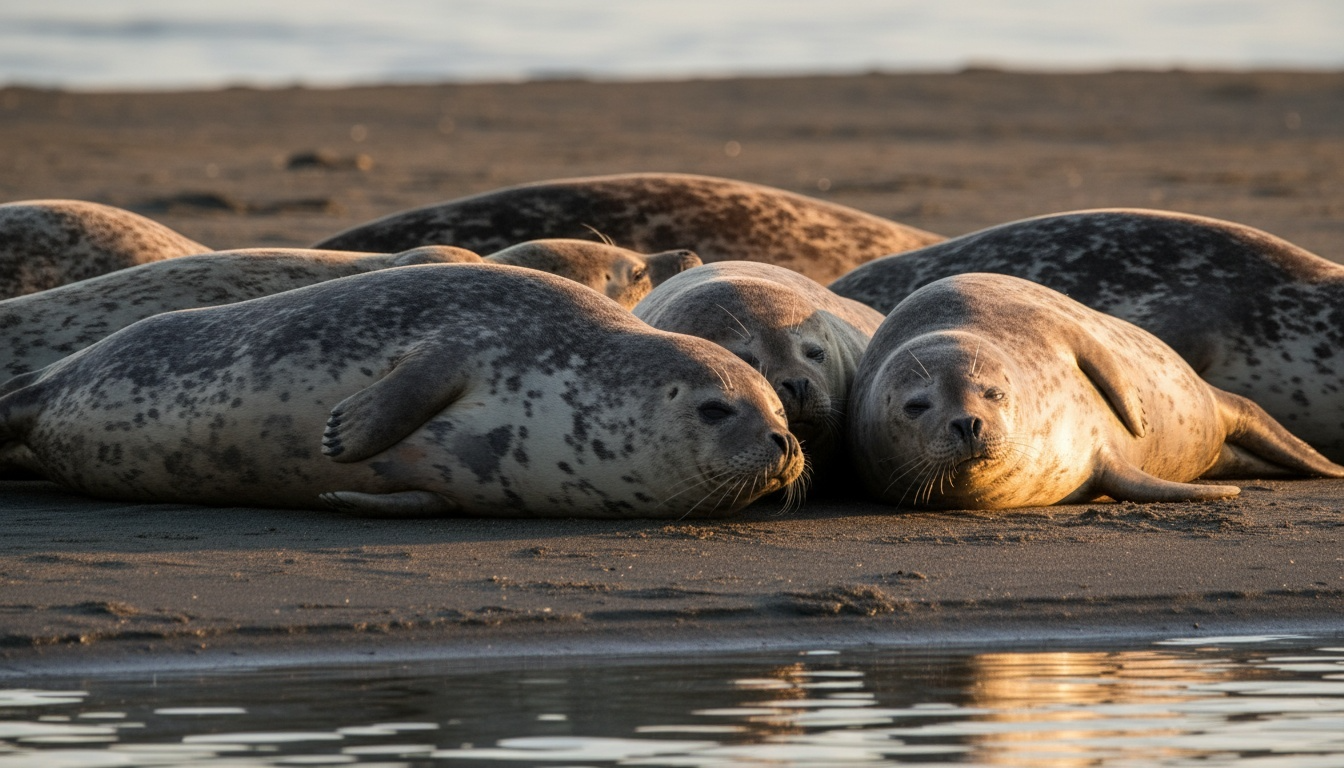
Harbor seals gathered on a sandbar at Alsea Bay in Waldport, Oregon
Understanding the Complex Relationship Between Marine Mammals and Fish in Waldport's Waters
When I first moved to Waldport, I thought the biggest threat to our salmon was overfishing or habitat loss. But after watching harbor seals hunt right off the Alsea Bay Bridge—and talking with frustrated local anglers who've lost fish to these whiskered opportunists—I realized the truth about our coastal ecosystem is far more complex than most people imagine.
If you're wondering whether those 400+ seals lounging on the sandbars each day are eating their way through our salmon runs, you're not alone. And more importantly, there's actual scientific data that addresses this exact question.
Harbor seals gathered on a sandbar at Alsea Bay in Waldport, Oregon
Let's start with the basics. Alsea Bay hosts one of the most significant harbor seal populations on the Oregon coast—second only to the Columbia River. According to Oregon Department of Fish and Wildlife (ODFW) monitoring studies, approximately 400 harbor seals call Alsea Bay home year-round, with counts occasionally reaching 459 individuals during peak haul-out periods.
These aren't seasonal visitors, either. Unlike California sea lions that migrate south for breeding season, Pacific harbor seals (Phoca vitulina richardii) maintain permanent residence in our bay. They haul out primarily at three locations: the West Bridge, East Bridge, and Mac Marina areas—places any Waldport resident knows well.
Here's where it gets really interesting—and where we need to look at actual data instead of anecdotal frustration. Between 1997 and 2002, ODFW's Marine Mammal Program conducted extensive research specifically focused on pinniped predation on salmon in the Alsea River system.
In fall 2000, ODFW researchers spent 1,518 hours conducting surface feeding observations across 29 sites in Alsea Bay and the river. They documented 60 predation events—but here's the crucial detail: only 11% of the observed salmonid kills were identified as coho salmon, while 24% were fall Chinook and 2% were winter steelhead. The remaining 63% couldn't be identified to species level.
So what does this mean for actual salmon run impacts? The researchers estimated that harbor seals consumed approximately 120 adult coho salmon during the study period. When compared to the estimated 2,414 wild coho spawners in the Alsea Basin that year, seal predation represented roughly 5% of the run.
Important context: When researchers extrapolated their findings to account for all daylight hours and locations they couldn't directly observe, the estimated impact rose to 18% of the coho run. However, this higher estimate assumes their sample was perfectly representative—which is a significant assumption.
Perhaps the most fascinating finding? One individual seal was responsible for at least 10% (possibly up to 16.6%) of all observed predation events over just a two-week period at a single site. Researchers tagged 62 seals with individually identifiable head patches and found that only 23% of marked seals were ever observed predating salmon in the river at all.
What this tells us is that seal predation isn't evenly distributed across the population. A minority of individuals—perhaps those who've learned specific hunting techniques or know productive fishing spots—account for the majority of salmon consumption.
ODFW researchers tagged harbor seals to track individual predation behavior
Before we conclude that seals are salmon-eating machines, let's look at what they're actually consuming most of the time. ODFW collected 139 harbor seal scat samples from four haul-out sites in Alsea Bay. The analysis revealed something surprising to most casual observers:
Salmon represented only 8.9% of seal diet.
The most frequently occurring prey items were:
In other words, seals are generalist predators. They're eating whatever's abundant and easy to catch. During most of the year, that's bottom-dwelling flatfish and schooling sand lance—not salmon.
Now, here's where we need to step back and look at the forest instead of individual trees. Oregon's coastal salmon populations—including those in the Alsea River—face multiple, interconnected challenges. Blaming seals alone ignores the more significant factors affecting salmon survival.
According to ODFW fisheries biologist Dr. Ted Nickelson's research on Oregon coastal coho populations, marine survival rates during ocean residence are the overriding factor in determining population health. When ocean conditions are favorable and young salmon survive their years at sea in high numbers, seal predation on returning adults has minimal population-level impact.
Conversely, when marine survival is poor—as happened during the "warm blob" years of 2014-2016—any additional mortality source becomes more significant. As ODFW researcher Pete Lawson noted in his 1999 analysis: "At low marine survival rates any additional mortality, from mammals, birds, fish, or humans, increases risk to populations. At higher levels of marine survival the salmon population size may be affected by predation, but extinction risk is likely to be low."
The Alsea River system is actually in relatively good shape compared to many Oregon coastal watersheds. Nickelson's assessment of Oregon's coastal coho populations found that the Alsea population complex was "viable and at a low risk of extinction," owing largely to the substantial amount of high-quality spawning and rearing habitat still available.
Compare this to degraded watersheds with limited spawning habitat, extensive riparian logging, or agricultural runoff—those populations face far greater challenges than seal predation.
Think of it this way: If your bathtub is draining because you left the drain open (poor marine survival and habitat degradation), adding a teaspoon of water per minute (reducing seal predation) isn't going to keep the tub full. You need to address the primary leak first.
While we're on the subject of marine mammal predation, it's worth distinguishing between harbor seals and California sea lions. Sea lions present a dramatically different predation scenario, particularly at locations like Bonneville Dam on the Columbia River.
At Bonneville Dam, sea lions have learned to congregate below the fish ladders where adult salmon are concentrated, essentially ambushing fish in a confined space. Northwest Power and Conservation Council data indicates that sea lions may consume up to 40% of the spring Chinook run at Bonneville—a far cry from the 5-18% impact estimated for harbor seals in Alsea Bay.
California sea lions are only occasional visitors to Alsea Bay. During the entire 2000 ODFW study period, researchers observed solitary sea lions on just three occasions, and only one sea lion predation event was documented.
I've heard the frustrated comments at the Port of Alsea and on local fishing forums: "Why don't they just get rid of some seals?" The answer is federal law—specifically, the Marine Mammal Protection Act (MMPA) of 1972.
The MMPA makes it illegal to harass, hunt, capture, or kill any marine mammal in U.S. waters. Harbor seals, like all marine mammals along the Pacific coast, are federally protected. Population recovery from historic hunting bounties (yes, Oregon and Washington once paid bounties for dead seals) is actually a conservation success story.
In the early 1900s, harbor seal populations were severely depleted by commercial hunting and government-sponsored bounty programs. The MMPA allowed populations to recover to healthy levels—which is precisely what we're seeing today.
Limited exceptions exist, but the bar is extremely high. The Endangered Salmon Predation Prevention Act allows for lethal removal of California sea lions (not harbor seals) that are specifically predating on ESA-listed salmon or steelhead at specific "pinch points" like fish ladders.
Even then, individual animals must be documented predating salmon multiple times, and non-lethal deterrents must have failed first. This level of documentation and intervention hasn't been pursued for harbor seals in Alsea Bay, where predation impacts appear significantly lower than threshold levels that would trigger such actions.
Understanding the Alsea Bay ecosystem requires thinking beyond simple predator-prey relationships. The Oregon Conservation Strategy's nearshore ecoregion assessment emphasizes that coastal food webs are interconnected through nutrient cycling, habitat usage, and multiple trophic levels.
Harbor seals are apex predators, yes. But they're also integral components of a functioning ecosystem. Their foraging behavior influences fish distribution patterns. Their feces contribute marine-derived nutrients back into the system. Dead seals that wash ashore provide food for scavengers and decomposers.
Seals aren't even the only fish predators in Alsea Bay. The system supports:
When we focus exclusively on seal predation, we risk missing the larger picture of how all these factors interact and compound.
I completely understand the frustration of Waldport anglers who watch seals snatch fish right off their lines. That's real, it happens, and it's maddening when you've been working a good hole all morning. But individual fishing experiences—as viscerally frustrating as they are—don't necessarily reflect population-level impacts.
A seal eating a salmon right in front of you is memorable. The thousands of salmon that successfully spawn without ever encountering a seal? Those don't make the same impression. This is classic availability bias—we remember the dramatic events, not the uneventful majority.
From a local fishing guide: "I've been fishing Alsea Bay for 30 years. Yes, seals will take fish sometimes. But I've also seen years with terrible returns when seals were hardly around, and good years when they were everywhere. The ocean conditions matter way more than the seals do."
Current indications suggest we may be entering a period of improved ocean conditions for salmon. The Pacific Decadal Oscillation and other ocean climate cycles appear to be shifting toward conditions more favorable for salmon survival.
If marine survival rates improve—and the Alsea River's high-quality habitat remains intact—we should see coho populations rebound regardless of seal predation levels. If populations don't recover despite improved ocean conditions, then scientists might need to look more closely at other factors, including predation.
ODFW continues monitoring both seal populations and salmon returns. They've refined their research methods since the early 2000s studies, and newer Pacific marine mammal stock assessments provide updated population estimates.
Yes, juveniles were found in 3.2% of seal scat samples. However, juvenile salmon predation is difficult to observe directly and may be underestimated in surface observation studies. The ODFW study focused primarily on adult salmon predation during fall return runs.
You're not imagining it. Harbor seal populations have recovered substantially since the Marine Mammal Protection Act ended hunting and bounty programs. Oregon's current population of 10,000-12,000 seals represents a successful conservation outcome, not an "overpopulation" in ecological terms.
Possibly, under specific circumstances. When marine survival is already low and spawning habitat is limited, even modest additional mortality from seals could have additive effects. However, research indicates that addressing habitat degradation and ocean survival factors would have far greater benefit than reducing seal predation.
Yes. The Marine Mammal Protection Act applies to all U.S. territorial waters. State agencies like ODFW cannot override federal protections without specific authorization from NOAA Fisheries, which would require documented evidence of significant impact on ESA-listed species.
Move to a different location—seals quickly learn where easy meals are available. Vary your fishing times and locations. Most importantly, never feed seals (it's illegal) or attempt to harass them away (also illegal and dangerous). Report injured or sick seals to NOAA's Marine Mammal Stranding Hotline: 1-866-767-6114.
Alsea Bay has the second-largest harbor seal population on the Oregon coast (after the Columbia River), but predation rates appear similar to or lower than other studied locations like the Rogue River. The accessible, well-studied nature of Alsea Bay means we have better data here than many other systems.
So, are harbor seals affecting salmon populations in Alsea Bay? The answer is nuanced: Yes, but probably not as much as you might think, and certainly not as much as other factors.
Based on the best available science:
Rather than framing this as "seals versus salmon," perhaps we should view it as a matter of managing expectations in a recovering ecosystem. We're fortunate in Waldport to have both healthy marine mammal populations and relatively robust salmon runs. That's a sign of ecological health, even if individual encounters can be frustrating.
The real threats to our salmon—climate change, ocean acidification, habitat degradation, and poor marine survival—require bigger solutions than seal management ever could provide. Those are the battles worth fighting if we want to ensure our grandchildren can still fish for Chinook off the Alsea Bay Bridge.
All sources accessed and verified October 2025